Table of Contents
Introduction
The 2024 United States presidential election in Wisconsin is shaping up to be one of the most watched and influential elections in the country. Known as one of America’s key swing states, Wisconsin often plays a major role in determining who becomes the next president. That makes every Wisconsin voter’s voice more important than ever.
In the last three elections, Wisconsin was decided by just thousands—or even hundreds—of votes. With such tight races, the attention from both major parties will be intense in 2024. Presidential candidates will make stops across cities like Madison, Milwaukee, Green Bay, and Eau Claire. Ads, town halls, and voter outreach will be seen all over the state.
This article will explain everything voters need to know—important dates, how to register, who’s running, and what issues matter most. We’ve written it in a friendly, simple tone, so readers of all ages and backgrounds can follow along. Let’s explore why the 2024 United States presidential election in Wisconsin might just decide the future of the country.
Wisconsin: A Key Battleground State
Wisconsin has 10 electoral votes in the U.S. Electoral College. That might not sound like a lot, but in a close national election, those 10 votes could decide who wins the presidency.
In 2016, Donald Trump won Wisconsin by just under 23,000 votes. In 2020, Joe Biden flipped the state back by around 20,000 votes. That means fewer than 50,000 votes made the difference over two elections. With such tight margins, it’s no wonder candidates are paying close attention to the 2024 United States presidential election in Wisconsin.
Voters here come from all backgrounds. The state includes large cities, small towns, farming communities, and college campuses—making it a true mix of America. That’s why Wisconsin is often called a “purple state”—not fully red or blue.
Who Is Running for President in 2024?
As of now, here are the major candidates expected to appear on ballots in the 2024 United States presidential election in Wisconsin:
- Joe Biden (Democrat): Serving as the current president, he is running for re-election.
- Donald Trump (Republican): The former president seeks to return to office.
- Robert F. Kennedy Jr. (Independent): Supported by voters who feel left out by both major parties.
- Cornel West (Independent): A new face bringing big change ideas to the race.
- Jill Stein (Green Party): Focused on climate, education, and healthcare justice.
Each of these candidates brings different ideas and policies. Wisconsin voters will have a choice between very different visions for the country’s future.
Key Election Dates in Wisconsin
Here are all the important dates you should keep in mind for the 2024 United States presidential election in Wisconsin:
- Voter registration deadline (online & mail): October 16, 2024
- In-person early voting starts: October 22, 2024
- Deadline to request an absentee ballot: October 31, 2024
- Election Day: Tuesday, November 5, 2024
- Deadline to return absentee ballots: Must arrive by 8 p.m. on Election Day
Voting early or by mail gives you more flexibility and helps avoid crowds. Just don’t forget to plan ahead, especially if you decide to vote by absentee ballot.
How to Register to Vote in Wisconsin
If you’re not registered yet, don’t worry. Wisconsin makes it easy to sign up.
Here are your options:
Online: Use the official Wisconsin MyVote website. You’ll need a valid Wisconsin ID.
By Mail: Print a registration form, fill it out, and mail it before the deadline.
In Person: Go to your local municipal clerk’s office.
On Election Day: Wisconsin allows same-day registration with proper ID and proof of address.
For many voters, the easiest choice is online registration. But if you’re new to Wisconsin or want help, clerks are available in every town to guide you.
Early Voting and Absentee Ballots
One of the best ways to avoid long lines on Election Day is to vote early. Wisconsin offers in-person early voting starting two weeks before the election. You can visit your local clerk’s office or an approved early voting site between October 22 and November 4.
Absentee voting is also available for anyone, no reason needed. Here’s how it works:
- Request a ballot at myvote.wi.gov
- Fill it out at home
- Mail or drop it off in person—just make sure it arrives by 8 p.m. on November 5
In the 2024 United States presidential election in Wisconsin, early and absentee voting could be a big factor—just like in previous years.
What Issues Matter Most to Wisconsin Voters?
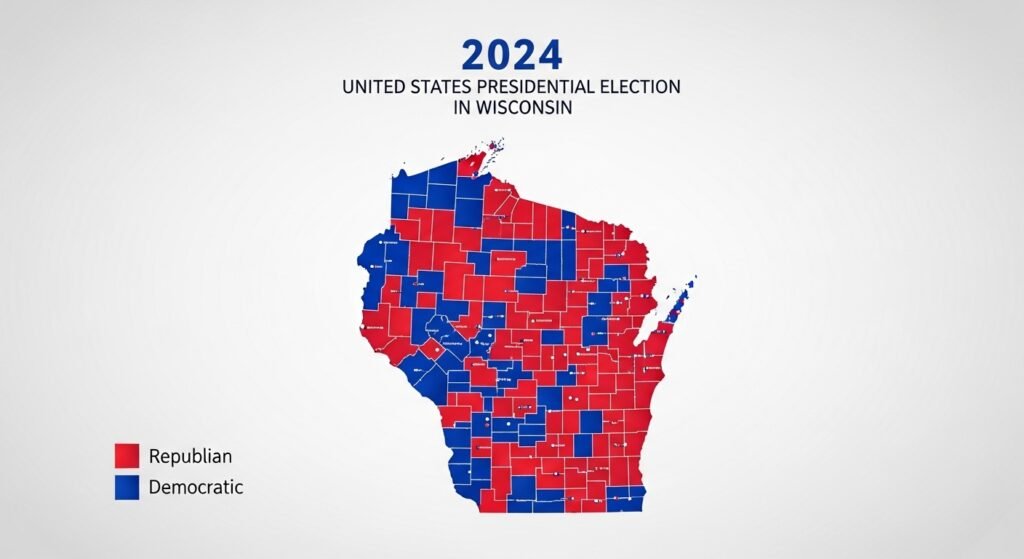
Every voter has their own top issue. In the 2024 United States presidential election in Wisconsin, common concerns include:
Jobs & Economy: With factories and farms across the state, jobs and wages are critical.
Healthcare: High costs, rural access, and insurance choices are hot-button issues.
Education: Many families are hoping for better school funding and increased teacher support.
Farming and Dairy: Protecting Wisconsin agriculture is a major goal for rural voters.
Abortion and Reproductive Rights: After Roe v. Wade was overturned in 2022, this issue has fired up voters.
Climate and Environment: With so many lakes, waterways, and outdoor jobs, climate policy hits close to home.
Each candidate offers different ideas and plans for these issues, and Wisconsin voters are watching closely.
Swing Counties in Wisconsin to Watch
Swing counties are those that can vote for either party, depending on the year. In close elections, winning just a few swing counties can decide the whole state.
Here are the top swing counties analysts are watching for the 2024 United States presidential election in Wisconsin:
- Brown County: Home to Green Bay, this is usually very close.
- Dane County: Includes Madison, a college town with many young voters.
- Waukesha County: A Republican stronghold, but becoming more competitive.
- Outagamie County: A toss-up area in past presidential contests.
Political ads and campaign visits often focus on these regions because just a few thousand votes in each can be the game-changer.
First-Time and Young Voters Are Taking the Lead
A large number of young and first-time voters are expected for the 2024 United States presidential election in Wisconsin. That includes high school seniors, college students, and new residents.
In Wisconsin, you can pre-register to vote at 17 years old—if you’ll be 18 by Election Day. Many schools, universities, and youth groups are helping young voters learn how the process works.
Young voters care a lot about topics like the environment, student loans, racial justice, and job security. That’s why campaigns are trying harder than ever to connect with Gen Z voters in new ways—especially on social media platforms like TikTok and Instagram.
Combating Misinformation and Voting Myths
Every election comes with rumors and confusion. It’s important to know what’s true and where to get accurate information, especially for the 2024 United States presidential election in Wisconsin.
Common myths and the facts:
Myth: You can’t vote if you’re in college out of state.
Fact: You can vote using your Wisconsin address or request an absentee ballot.
Myth: You need a driver’s license to vote.
Fact: You do need a valid photo ID, but it doesn’t have to be a driver’s license.
Myth: If you vote absentee, your vote doesn’t count.
Fact: Absentee ballots are just as valid as in-person ones—if they arrive on time.
For trusted info, use official sources like myvote.wi.gov or call your local clerk’s office.
What Happens on Election Day?
If you plan to vote in person on Tuesday, November 5, 2024, here’s what to expect:
- Polls are open from 7 a.m. to 8 p.m.
- You must bring a valid ID (driver’s license, state ID, U.S. passport, or others listed online).
- If you’re not registered, you can still register at your polling place with proof of residency.
- If you’re already in line by 8 p.m.—you can still vote, no matter how long the line is.
Poll workers (often local volunteers) will be there to help answer questions and guide you through the process.
Why Every Vote Counts in Wisconsin
In close elections, one vote truly can make a difference—and it’s happened in Wisconsin before.
In 2016, Trump won the state by fewer than 23,000 votes. In 2020, Biden won by roughly the same margin. That’s less than 1% of the total votes.
That means the 2024 United States presidential election in Wisconsin could be won or lost by just one vote in each neighborhood, school, or town. That’s why it’s so important for every eligible voter to be involved.
FAQs
1. When is the 2024 presidential election in Wisconsin?
Election Day is Tuesday, November 5, 2024. Early voting begins on October 22.
2. Can I vote by mail in Wisconsin?
Yes. You can request an absentee ballot through myvote.wi.gov. Just return it by 8 p.m. on Election Day.
3. What ID do I need to vote in Wisconsin?
A photo ID is required. Driver’s licenses, U.S. passports, student IDs, and military IDs are accepted.
4. Can I register to vote on the same day?
Yes! Wisconsin allows same-day registration at your polling place with proof of address.
5. Where can I see a sample ballot for my district?
Visit myvote.wi.gov to view what your ballot will look like based on your voting district.
6. Can 17-year-olds vote in Wisconsin?
Yes, but only if you’ll be 18 by Election Day. You can pre-register ahead of time.
Conclusion
The 2024 United States presidential election in Wisconsin is more than just another political event—it’s a defining moment in the nation’s future. And Wisconsin is once again in the spotlight.
No matter what issue matters most to you—jobs, the economy, healthcare, the environment, education, or freedom—you have the power to shape what comes next. Leaders are elected by those who show up.
So register, make a voting plan, encourage friends and family to vote, and stay informed. If you’re a Wisconsin voter, your voice carries weight. Don’t waste it.